Older architecture throughout Buffalo, such as Queen Anne multi-family homes in Allentown, classic stone-foundation doubles in the West Side, and brick properties along Parkside near Delaware Park, presents complex…
Older architecture throughout Buffalo, such as Queen Anne multi-family homes in Allentown, classic stone-foundation doubles in the West Side, and brick properties along Parkside near Delaware Park, presents complex subterranean microclimates. Unfinished fieldstone basements, porous mortar joints, and dirt crawl spaces maintain elevated relative humidity levels above 70%, creating ideal hunting grounds for cellar spiders, wolf spiders, and multi-legged house centipedes (*Scutigera coleoptrata*). Occasional invaders do not typically consume structural wood, but their nocturnal movement across baseboards, bedrooms, and food preparation areas signals an underlying moisture failure or secondary pest population serving as their primary food source.
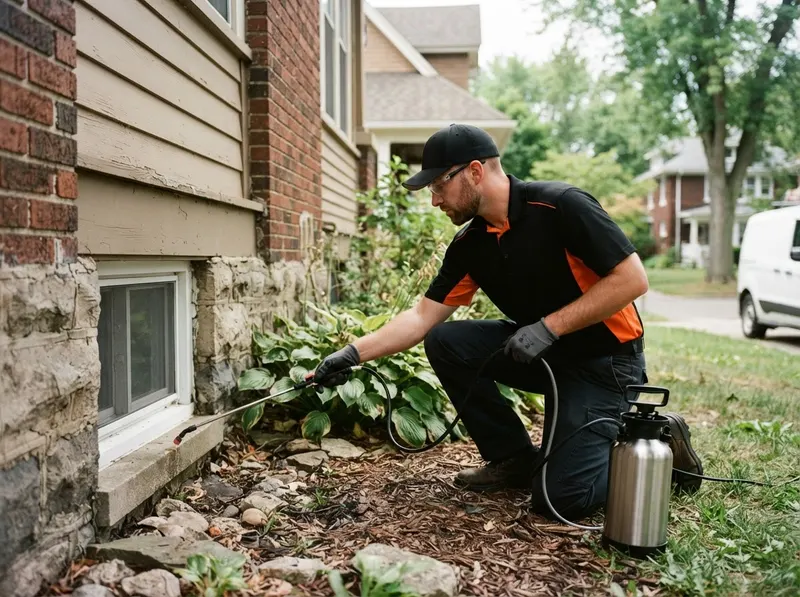
Effective management requires differentiating between incidental perimeter strays and established interior populations. Ground-floor invasions in neighborhoods like Kaisertown, the First Ward, and South Buffalo often peak during late-summer heat and mid-autumn temperature drops, driving outdoor species indoors through ground-level vents, unsealed dryer exhausts, and damaged weatherstripping. Standard consumer aerosol sprays deliver low-potency knockdown agents that disperse these arthropods deeper into wall cavities and subflooring without halting ingress. Guardian Pest Solutions utilizes micro-encapsulated exterior perimeter bands applied 3 feet up the foundation wall and 5 feet outward along the soil line, intercepting crawling pests before entry points are reached.
Indoor control focuses on mechanical de-webbing with HEPA-filtered vacuum systems and localized non-staining micro-emulsions placed precisely within sill plates, pipe penetrations, and structural gaps. This targeted application eliminates high-volume chemical saturation in primary living spaces, ensuring treated areas remain fully accessible to occupants and domestic pets once dried (typically within 60 to 90 minutes). The technical trade-off between exterior foundation sealing and broad-spectrum chemical reliance favors structural exclusion: applying expanding polyurethane foams or copper mesh to baseline utility voids permanently prevents invasion, whereas chemical barriers degrade under Western New York freeze-thaw cycles and heavy lake-effect moisture over 60 to 90 days.
Every job gets a firm, written price after a free on-site visit.
Tell us about your spider and occasional invader management job in Buffalo and we'll send a clear, written quote, usually the same day.
 Guardian Pest Solutions